TL;DR: Shockwave therapy uses acoustic waves to treat chronic musculoskeletal pain by triggering natural healing processes. Success rates range from 60-98% depending on condition, with the strongest evidence for plantar fasciitis, tendon injuries, and frozen shoulder. It’s a non-invasive alternative between conservative care and surgery, requiring 3-6 sessions of 15-30 minutes each.
Shockwave therapy delivers:
-
60-80% effectiveness for plantar fasciitis, with some protocols achieving 98% success at one year
-
Non-invasive treatment requiring no anesthesia or recovery time
-
Mechanical stimulation that triggers angiogenesis, collagen remodeling, and natural tissue repair
-
Best results when combined with guided rehabilitation or nutritional support
-
A viable option between conservative care and surgery for chronic conditions
Shockwave therapy has moved from experimental to established over the past two decades. Originally developed to break up kidney stones, the technology now treats chronic pain conditions that resist conventional approaches.
The treatment delivers acoustic waves to injured tissue. These waves trigger mechanical forces that start a cascade of biological responses—promoting healing, reducing inflammation, and rebuilding damaged structures without surgery or extended recovery time.
Recent clinical data shows why more practitioners are adding this tool to their treatment protocols.
What Is Shockwave Therapy and How Does It Work?
Extracorporeal shockwave therapy (ESWT) operates through mechano-transduction. The acoustic waves create mechanical stress in biological tissue, which activates cellular signaling pathways that weren’t responding to other interventions.
This isn’t about masking pain. The treatment stimulates angiogenesis (new blood vessel formation), enhances collagen remodeling, and triggers the body’s natural repair mechanisms in areas where healing had stalled.
A 2025 evidence synthesis published in Biomedicines established ESWT as part of a “regenerative triad” with moderate-to-high certainty evidence. The research noted it promotes mechanotransduction, angiogenesis, and extracellular matrix remodeling—the foundational processes needed for tissue repair.
Bottom line: Shockwave therapy stimulates healing through mechanical forces, not symptom masking. It triggers angiogenesis, collagen remodeling, and tissue repair in areas where healing had stalled.
What Does Recent Research Show About Shockwave Therapy?
The evidence base has strengthened considerably in 2024-2025.
A May 2025 meta-analysis in Physical Therapy journal found that shockwave therapy significantly improves pain and range of motion in patients with adhesive capsulitis (frozen shoulder) in adults with type II diabetes. The benefit increased when combined with guided rehabilitation.
For knee osteoarthritis, a July 2024 randomized controlled trial in Scientific Reports showed greater reductions in pain and improvements in daily function after 8 weeks compared to control groups. Researchers noted the treatment’s potential to delay or reduce the need for injections or surgery in mild-to-moderate cases.
A June 2025 study in Frontiers in Rehabilitation Sciences discovered something interesting about combination approaches. When researchers paired extracorporeal shockwave therapy with nutraceutical supplements, they saw significantly improved tendon healing and pain reduction compared to either treatment alone. The combination enhanced collagen remodeling and reduced inflammation in conditions like Achilles or gluteal tendinopathy.
Research snapshot: Meta-analyses and RCTs from 2024-2025 demonstrate significant improvements in pain and function across multiple conditions, with enhanced results when combined with rehabilitation or nutritional support.
How Effective Is Shockwave Therapy for Different Conditions?
The treatment shows variable effectiveness depending on the condition and patient factors.
Plantar fasciitis shows effectiveness rates between 60-80% for patients who complete the treatment protocol. A prospective study of 149 patients (168 heels) with chronic plantar fasciitis found that the shockwave group achieved 69.1% excellent results with a recurrence rate of only 11%.
An individualized radial ESWT protocol for plantar fasciopathy showed success rates of 19% at 1 month, 70% at 3 months, and 98% at 1 year, with only an 8% recurrence rate over the follow-up period.
Chronic low back pain showed promise in a meta-analysis of 632 patients. ESWT provided better pain relief and improved lumbar dysfunction compared with other interventions, with no serious adverse effects found.
Bone healing presents a more complex picture. Out of 1,200 total long bone nonunions treated with ESWT, 876 (73%) healed. Hypertrophic cases achieved 3-fold higher healing rates compared to oligotrophic or atrophic cases. Shorter periods between injury and treatment led to higher healing rates.
A systematic review involving 1,460 patients across 28 randomized controlled trials comparing ESWT to laser therapy found ESWT effective across multiple outcome measures including pain, functionality, strength, range of motion, and quality of life.
Success rate summary: Effectiveness varies by condition—plantar fasciitis (60-98%), bone healing (73% for nonunions), and chronic low back pain shows superior outcomes versus other interventions. Patient-specific factors and timing influence results.
Is Shockwave Therapy an Alternative to Surgery?
The FDA first approved ESWT for proximal plantar fasciitis in 2000 and lateral epicondylitis in 2002. Success rates ranged from 65% to 91% with low, negligible complications.
For many patients with chronic soft tissue injuries, shockwave therapy delivers comparable pain relief to surgery with fewer risks. Sessions typically last 15 to 30 minutes, require no anesthesia, and allow patients to resume normal activities immediately after treatment.
A systematic review concluded that ESWT is an effective and safe non-invasive treatment option for tendon and other pathologies of the musculoskeletal system. The optimum treatment protocol identified was three treatment sessions at 1-week intervals, with 2,000 impulses per session and the highest energy flux density the patient can tolerate.
The surgical comparison: Shockwave therapy delivers comparable pain relief to surgery for many chronic soft tissue injuries, with fewer risks, no anesthesia, and immediate return to activities. Optimal protocol: three sessions at 1-week intervals.
What Does Treatment Feel Like and How Long Does It Take?
The treatment accelerates tissue regeneration and reduces pain more quickly than conservative treatments alone. Research indicates healing increases by 50% compared to other treatment styles, with patients often experiencing significant improvements after just a few sessions.
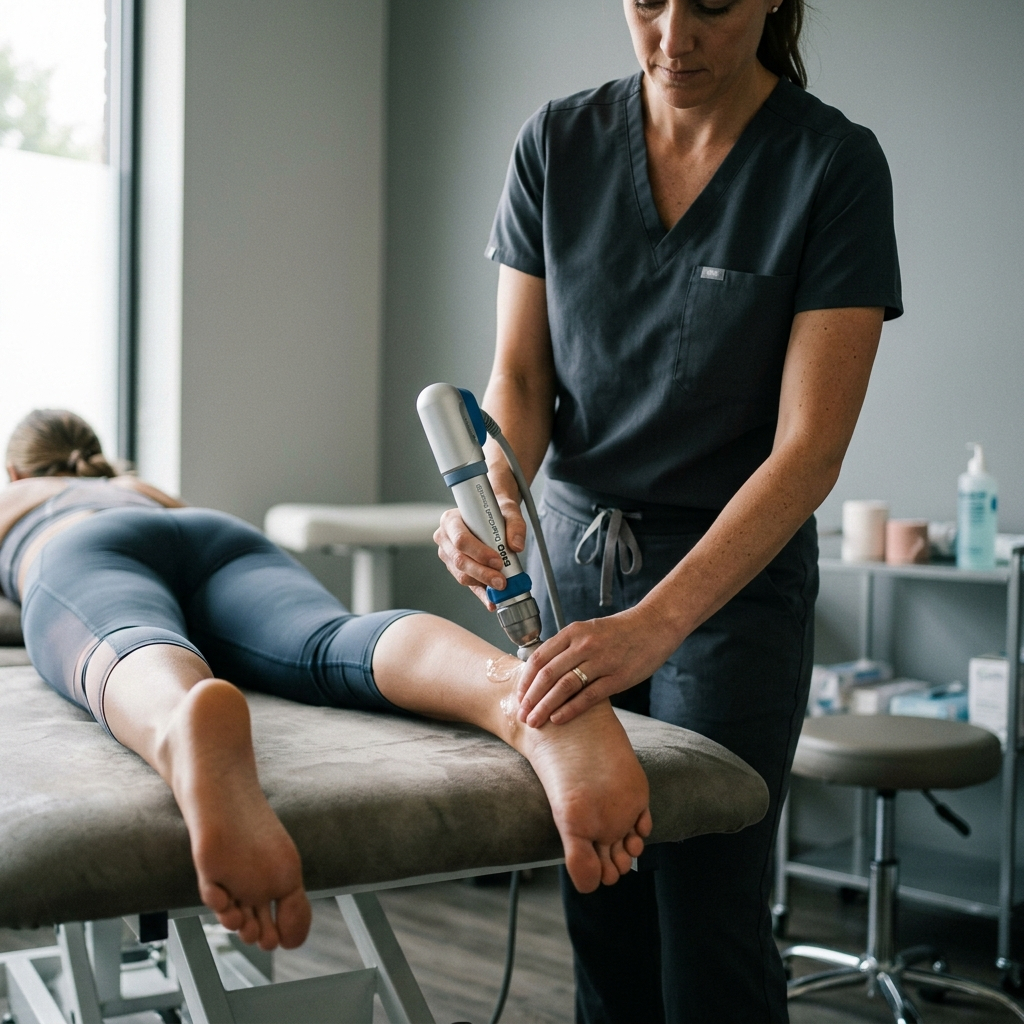
The procedure itself is straightforward. Practitioners apply a gel to the treatment area and use a handheld device to deliver the acoustic waves. Patients describe the sensation as tolerable discomfort rather than sharp pain. No needles, no incisions, no extended downtime.
This matters for the patient who has tried physical therapy, changed their activities, and still deals with persistent pain that limits what they can do. The treatment offers lasting relief by stimulating the body’s natural healing processes rather than temporarily masking symptoms.
Patient experience: Treatments last 15-30 minutes with tolerable discomfort, no needles or incisions, and no downtime. Healing accelerates by 50% compared to conservative treatments alone, with significant improvements often seen after a few sessions.
When Should Shockwave Therapy Be Used in a Treatment Plan?
Shockwave therapy works best as part of a comprehensive approach rather than as a standalone intervention.
The research on combination treatments shows this clearly. When paired with guided rehabilitation, the outcomes improve. When integrated with appropriate nutritional support, tissue healing accelerates. When used at the right point in the treatment timeline—after conservative care but before surgical intervention—it fills a gap that previously pushed patients toward more invasive options.
This positioning matters for practitioners building treatment protocols. The technology provides an option between “keep doing what isn’t working” and “schedule surgery.” For patients dealing with chronic conditions that haven’t responded to initial conservative care, it offers a path forward that doesn’t require them to accept either ongoing limitation or surgical risk.
Strategic positioning: Shockwave therapy fills the gap between conservative care and surgery. It works best as part of a comprehensive approach, combined with rehabilitation and nutritional support, for patients who haven’t responded to initial treatments.
What Should You Know Before Considering Shockwave Therapy?
The clinical data published in 2024 and 2025 strengthens the case for shockwave therapy in specific applications. The treatment shows consistent effectiveness for plantar fasciitis, demonstrates promise for tendon injuries and osteoarthritis, and provides a non-invasive option for patients who haven’t responded to initial conservative care.
The mechanism is understood. The safety profile is established. The outcomes are documented across multiple conditions and patient populations.
What remains variable is the individual response. Not every patient achieves the same results, and factors like injury type, duration of symptoms, and overall health status influence outcomes. The treatment works best when integrated into a comprehensive care plan that addresses the underlying factors contributing to the injury.
For practitioners looking to expand their treatment options, the evidence supports shockwave therapy as a legitimate tool. For patients dealing with chronic musculoskeletal pain that hasn’t responded to conventional approaches, it represents a viable option worth discussing with their healthcare provider.
The technology has moved beyond experimental status. The question now is where it fits in each individual treatment plan.
Frequently Asked Questions About Shockwave Therapy
How many shockwave therapy sessions do I need?
Most patients require 3-6 sessions spaced one week apart. Research indicates the optimal protocol is three treatment sessions with 2,000 impulses per session at the highest energy flux density you can tolerate.
Does shockwave therapy hurt?
Patients describe the sensation as tolerable discomfort rather than sharp pain. The treatment requires no anesthesia, and any discomfort is temporary during the 15-30 minute session.
How long before I see results from shockwave therapy?
Timeline varies by condition. Some patients experience relief within weeks, while others see progressive improvement over months. For plantar fasciitis, studies show 19% success at 1 month, 70% at 3 months, and 98% at 1 year.
Can I return to normal activities after shockwave therapy?
Yes. Because the treatment is non-invasive and requires no anesthesia, patients can resume normal activities immediately after each session. There’s no extended recovery time required.
What conditions respond best to shockwave therapy?
The strongest evidence exists for plantar fasciitis, tendon injuries (Achilles, gluteal), frozen shoulder, lateral epicondylitis (tennis elbow), knee osteoarthritis, chronic low back pain, and bone healing in nonunions.
Is shockwave therapy covered by insurance?
Coverage varies by provider and condition. Because the FDA approved ESWT for specific conditions starting in 2000, many insurance plans cover it when medically necessary. Check with your provider for specific coverage details.
What’s the difference between radial and focused shockwave therapy?
Radial shockwave (rESWT) disperses energy over a broader area and treats superficial conditions. Focused shockwave (fESWT) concentrates energy at a specific depth for deeper tissue pathologies. Your practitioner will determine which type suits your condition.
Can shockwave therapy replace surgery?
For many chronic soft tissue injuries, shockwave therapy delivers comparable pain relief to surgery with fewer risks. It’s positioned as an option between conservative care and surgical intervention, though not all conditions can avoid surgery through ESWT alone.
Key Takeaways
-
Shockwave therapy triggers natural healing through mechano-transduction, stimulating angiogenesis, collagen remodeling, and tissue repair in areas where healing had stalled
-
Success rates range from 60-98% depending on condition and protocol, with the strongest evidence for plantar fasciitis, tendon injuries, and frozen shoulder
-
The treatment is non-invasive with no anesthesia required, sessions lasting 15-30 minutes, and immediate return to normal activities
-
Optimal protocol involves three sessions at 1-week intervals with 2,000 impulses per session at the highest tolerable energy level
-
Shockwave therapy works best as part of a comprehensive treatment approach, showing enhanced results when combined with guided rehabilitation or nutritional support
-
It fills the strategic gap between conservative care and surgery for patients who haven’t responded to initial treatments
-
Individual response varies based on injury type, symptom duration, and overall health status—making it essential to discuss with your healthcare provider whether it’s appropriate for your specific situation