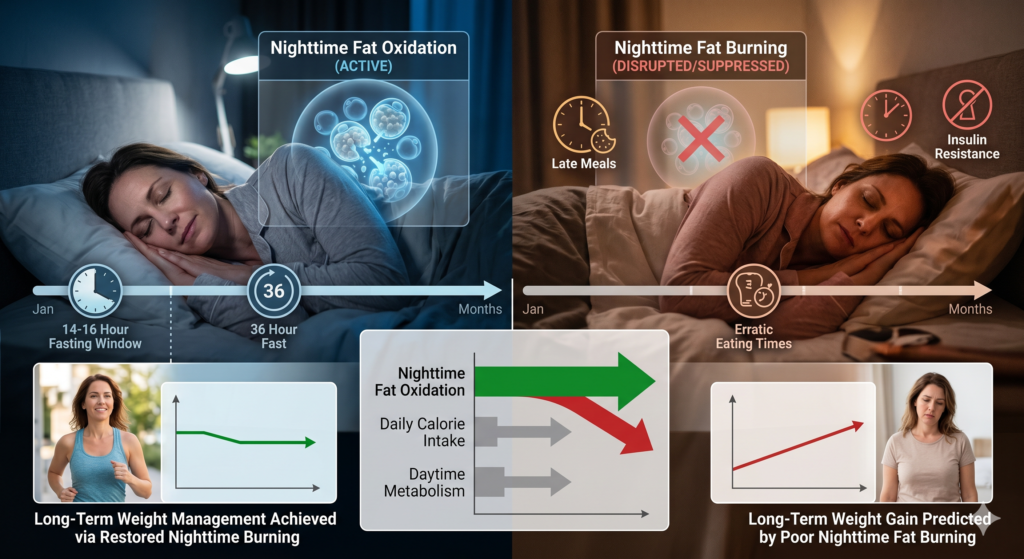
TL;DR: A five-year study found that nighttime fat oxidation predicts long-term weight gain better than daily calorie intake or daytime metabolism. Your body should burn fat during sleep, but late meals, insulin resistance, and poor timing disrupt this window. Extended overnight fasting (14-16 hours) and periodic 36-hour fasts restore nighttime fat burning by changing fuel preference, not just depleting glycogen stores.
Core Answer:
-
Nighttime fat oxidation explained 41% of weight gained over five years—more than total calories consumed
-
Circadian rhythms create a metabolic “cleanup window” during sleep when fat should be the primary fuel
-
Extended fasting (16 hours overnight) increases nocturnal fat oxidation without depleting liver glycogen
-
High-carbohydrate meals near bedtime suppress free fatty acid release and disrupt nighttime fat burning
-
Consistent 14-16 hour overnight fasts restore metabolic timing; periodic 36-hour fasts act as metabolic resets
Why Nighttime Fat Oxidation Matters More Than Daily Calories
A five-year study published in the journal Obesity found something that challenges most weight loss advice: nighttime fat oxidation predicted long-term weight gain better than daily caloric intake, daytime fat burning, or 24-hour metabolism combined. Lower nighttime fat oxidation alone explained 41% of weight gained over the study period.
Most people focus on daytime strategies—calorie restriction, intense workouts, macro management—but their metabolism makes opposite decisions during sleep.
The researchers tracked lean subjects through overfeeding protocols and measured metabolic changes. Short-term overfeeding had the most pronounced influence on nocturnal substrate utilization, not 24-hour or daytime patterns. In obesity-prone individuals, nocturnal fat oxidation decreased significantly while obesity-resistant subjects maintained their nighttime fat-burning capacity.
Bottom line: The problem isn’t what happens during waking hours—it’s what happens while you sleep.
What Is the Metabolic Cleanup Window?
Nighttime metabolism operates under strong circadian regulation. Free fatty acids naturally rise at night. Fat-burning enzymes like hormone-sensitive lipase and carnitine palmitoyltransferase 1 are rhythmically regulated. Growth hormone peaks during deep sleep to support fat oxidation.
This circadian regulation creates a metabolic “cleanup window”—a period when your body should be burning stored fat for fuel while you rest.
When this window gets disrupted by overfeeding, insulin resistance, or poor meal timing, the body defaults to carbohydrate burning even during sleep. Because this pattern compounds over time, your daytime efforts get undermined by what your metabolism does overnight.
Key insight: Nighttime metabolism operates under circadian control, creating a natural fat-burning window that modern eating patterns often disrupt.
How Fasting Changes Fuel Preference (Not Just Fuel Availability)
A randomized crossover trial published in Obesity in 2023 compared what happened when people extended their overnight fast from 9.5 hours to 16 hours. The study included both individuals with nonalcoholic fatty liver disease and healthy controls.
Result: Extended fasting led to lower nocturnal carbohydrate oxidation and higher fat oxidation in both groups.
The surprising finding: these changes weren’t caused by liver glycogen depletion. Fasting didn’t work by emptying glycogen stores—it worked by changing metabolic fuel preference, acting as a dimmer switch rather than an on-off mechanism.
Key insight: You don’t need to deplete yourself to restore fat burning. You need to create the metabolic environment where fat becomes the preferred fuel.
What Is the Gluconeogenesis Loop That Prevents Fat Burning?
People with fatty liver disease exhibit higher nocturnal carbohydrate oxidation because of increased gluconeogenesis—the liver producing glucose from non-carbohydrate sources like glycerol, lactate, and pyruvate.
When adipose tissue becomes insulin-resistant, the body continuously converts fat-derived substrates into carbohydrates and burns those instead. Therefore, this creates a perpetual carbohydrate-burning state, even when you’re not eating carbohydrates.
Fasting interrupts this loop because it reduces unnecessary glucose production and lowers insulin signaling, allowing fatty acids to be burned directly instead of being converted into glucose first.
Research published in JCI Insight found that nonalcoholic fatty liver disease impairs ketogenesis and increases acetyl-CoA oxidation in the tricarboxylic acid cycle, which positively correlated with rates of gluconeogenesis and plasma glucose concentrations. The metabolic pathology limits the disposal of lipids via ketogenesis, thereby favoring oxidative metabolism that increases gluconeogenesis and promotes elevated plasma glucose.
Key insight: Fasting breaks the gluconeogenesis loop, allowing the body to burn fatty acids directly rather than converting them to glucose first.
What Happens During a 36-Hour Fast?
Single 36-hour fasts studied in controlled metabolic chambers show that fat oxidation increases rapidly and peaks around 51 hours. In contrast, carbohydrate oxidation drops and remains low.
The day-night rhythm of energy expenditure stays intact—fasting doesn’t disrupt circadian metabolism. Instead, it realigns it.
This realignment involves a four-fold increase in beta-hydroxybutyrate (ketones) without increasing hunger or reducing resting metabolic rate. A study in the Journal of Applied Physiology found that after a 72-hour fast, postprandial carbohydrate oxidation was significantly reduced while fat oxidation was significantly increased, demonstrating that extended fasting creates sustained metabolic shifts beyond simple glycogen depletion.
A 36-hour water-only fast remodeled hundreds of plasma lipid species. These lipid molecules function as metabolic signals influencing inflammation, immune function, and metabolic flexibility. Therefore, fasting teaches the body when to burn fat—it doesn’t just burn fat temporarily.
Key insight: Extended fasting realigns circadian metabolism, increases ketone production four-fold, and remodels plasma lipids without reducing metabolic rate or increasing hunger.
How Does Perilipin 5 (PLIN5) Control Muscle Fat Access?
Intermittent fasting increases expression of perilipin 5 (PLIN5)—a protein regulating how muscles store and oxidize fat.
PLIN5 exists at the intersection of lipid droplets and mitochondria. It helps muscles access fat without flooding the system, essentially creating controlled fat oxidation on demand.
Key insight: This mechanism explains why fasting improves metabolic flexibility even when you’re not actively fasting—you’re training your muscles to access and burn fat more efficiently during both fed and fasted states.
Does Fasting Hurt Performance?
A 36-hour fast can reduce acute endurance performance. Time to exhaustion decreases when you’re depleted—this is expected.
However, this differs from using fasting as a metabolic training tool.
Time-restricted eating in elite cyclists showed no change in VO2 max but reduced body fat, improved inflammation markers, and enhanced power-to-weight ratios. Fasting doesn’t boost peak performance acutely—it improves the underlying metabolic function that sustained performance depends on.
The distinction matters. If you’re competing or requiring peak athletic output, modify or eliminate fasting protocols during those periods. Instead, use fasting during off-seasons or low-intensity training phases to build metabolic infrastructure that supports future performance.
Key insight: Fasting may reduce acute performance but improves long-term metabolic function. Time it strategically around training cycles, not competition periods.
How Does Meal Timing Affect Nighttime Fat Burning?
High-carbohydrate, high-insulin meals close to bedtime suppress free fatty acid release precisely when your body should be switching into fat-burning mode.
Research shows that late evening meals lead to higher overnight glucose levels and delayed fat burning, even when calories are matched. A study by Hibi et al. found that late night snacking increased both total and LDL cholesterol and reduced fat oxidation, therefore increasing the risk of obesity.
Because this timing disruption compounds over time, it creates long-term metabolic consequences despite potentially reasonable daily caloric intake.
Exception: Modest protein intake consumed approximately one hour before sleep. Whey protein or cottage cheese may enhance morning metabolic rate without disrupting nighttime fat oxidation because the protein doesn’t trigger the same insulin response as high-carbohydrate meals and provides amino acids for overnight muscle protein synthesis.
Key insight: Late-night high-carb meals suppress nighttime fat burning even when total calories remain constant. Modest pre-bed protein is an exception.
What Does This Mean for Your Weight Loss Strategy?
Because nighttime fat oxidation predicts weight gain independent of caloric intake, traditional one-size-fits-all dietary advice becomes less useful. The focus shifts from “what you eat” to “when you eat.”
Research suggests that metabolic responses to daytime energy imbalances manifest overnight while people sleep. Therefore, this period plays an important role in the regulation of body weight.
Time-restricted eating in participants with overweight or obesity improves insulin sensitivity and increases nocturnal fat oxidation. The beneficial metabolic effects are at least partially related to a more pronounced nocturnal fasting state reflected by higher rate of fat oxidation.
Key insight: Weight management depends less on total calories and more on metabolic timing. Focus on “when you eat” as much as “what you eat.”
How to Implement Nighttime Fat-Burning Strategies
Establish a Baseline Overnight Fast
Maintain a consistent 14-16 hour overnight fast as the baseline metabolic intervention. This duration is sufficient to restore nighttime fat oxidation without requiring extreme measures. Consistency matters more than intensity.
Time Your Last Meal Strategically
Avoid high-carbohydrate, high-insulin meals close to bedtime to prevent suppression of free fatty acid release during the critical nighttime fat-burning window.
Use Periodic Extended Fasts
Implement 36-hour fasts periodically—once every two weeks to monthly—as metabolic “resets” rather than routine practice. These should not coincide with heavy training blocks or periods requiring peak performance. View them as tools for reinforcing metabolic flexibility rather than primary fat loss mechanisms.
Prioritize Sleep Quality
Because nighttime fat oxidation depends on circadian regulation and deep sleep-associated growth hormone release, sleep quality becomes a primary metabolic intervention. Optimize sleep hygiene as foundational to metabolic health rather than treating it as secondary to dietary interventions.
Match Fasting to Your Training Cycle
Distinguish between acute performance demands and long-term metabolic health optimization. If competing or requiring peak athletic output, modify or eliminate fasting protocols during those periods. Use fasting during off-seasons or low-intensity training phases to build metabolic infrastructure.
Key insight: Start with consistent 14-16 hour overnight fasts, avoid late high-carb meals, use periodic 36-hour fasts as resets, and prioritize sleep quality above all.
The Paradigm Shift: From Calorie Counting to Metabolic Timing
The research on nighttime fat oxidation signals a fundamental shift in weight management understanding. Circadian biology is moving from niche research to mainstream health optimization.
Because 41% of five-year weight gain is explained by a single metabolic marker, long-term weight management success depends less on willpower or caloric discipline and more on establishing the correct metabolic environment.
Therefore, this shifts responsibility from individual behavioral failure to systemic metabolic dysfunction. The solution isn’t trying harder—it’s creating the conditions where your metabolism works with you instead of against you.
Your body is designed to burn fat during sleep. The efficiency of this process depends on factors you have direct control over: meal timing, fasting windows, sleep quality, and metabolic training through strategic nutrient timing.
The question isn’t whether you’re burning fat during the day. The question is what your metabolism does while you sleep.
Frequently Asked Questions
What is nighttime fat oxidation and why does it matter?
Nighttime fat oxidation is the process of burning stored fat for energy during sleep. Research shows it predicts long-term weight gain better than daily caloric intake, explaining 41% of weight gained over five years. Because your body should naturally burn fat during sleep, disrupted nighttime fat burning compounds over time and undermines daytime weight loss efforts.
How long should I fast overnight to restore nighttime fat burning?
A consistent 14-16 hour overnight fast is sufficient to restore nighttime fat oxidation without extreme measures. For example, if you finish dinner at 7 PM, don’t eat again until 9-11 AM the next day. Consistency matters more than intensity—maintaining this pattern nightly creates sustained metabolic benefits.
Will fasting hurt my workout performance?
A 36-hour fast can reduce acute endurance performance temporarily. However, time-restricted eating improves long-term metabolic function, body composition, and power-to-weight ratios in athletes. Therefore, use fasting during off-seasons or low-intensity training phases, and modify or eliminate fasting protocols during competition periods or heavy training blocks.
Can I eat anything before bed without disrupting fat burning?
High-carbohydrate meals close to bedtime suppress free fatty acid release and disrupt nighttime fat burning. However, modest protein intake (whey protein or cottage cheese) consumed approximately one hour before sleep may enhance morning metabolic rate without disrupting nighttime fat oxidation because protein doesn’t trigger the same insulin response as carbohydrates.
How does fasting change metabolism without depleting glycogen?
Fasting acts as a metabolic dimmer switch rather than an on-off mechanism. Extended overnight fasting (16 hours) increases nocturnal fat oxidation without depleting liver glycogen stores. Instead, fasting changes fuel preference by reducing insulin signaling and unnecessary glucose production, allowing fatty acids to be burned directly.
What happens during a 36-hour fast?
During a 36-hour fast, fat oxidation increases rapidly and peaks around 51 hours, while carbohydrate oxidation drops. The fast produces a four-fold increase in ketones without increasing hunger or reducing metabolic rate. It also remodels hundreds of plasma lipid species that influence inflammation, immune function, and metabolic flexibility.
How often should I do a 36-hour fast?
Implement 36-hour fasts periodically—once every two weeks to monthly—as metabolic “resets” rather than routine practice. These extended fasts should not coincide with heavy training or periods requiring peak performance. View them as tools for reinforcing metabolic flexibility, not primary fat loss mechanisms.
Does sleep quality really affect fat burning?
Yes. Because nighttime fat oxidation depends on circadian regulation and deep sleep-associated growth hormone release, sleep quality is a primary metabolic intervention. Growth hormone peaks during deep sleep to support fat oxidation, creating the metabolic “cleanup window.” Poor sleep disrupts this process regardless of fasting or meal timing.
Key Takeaways
-
Nighttime fat oxidation predicts weight gain more accurately than daily calories. A five-year study found that lower nighttime fat oxidation explained 41% of weight gained, making it more predictive than total caloric intake or daytime metabolism.
-
Extended overnight fasting changes fuel preference, not just fuel availability. A 16-hour overnight fast increases nocturnal fat burning without depleting liver glycogen by acting as a metabolic dimmer switch that shifts fuel preference toward fat.
-
Late-night high-carb meals suppress the nighttime fat-burning window. High-carbohydrate, high-insulin meals near bedtime suppress free fatty acid release precisely when your body should be burning fat, creating compounding metabolic consequences over time.
-
Fasting breaks the gluconeogenesis loop in insulin resistance. In fatty liver disease and insulin resistance, the body converts fat substrates into glucose and burns those instead. Fasting interrupts this loop, allowing direct fat oxidation.
-
Consistent 14-16 hour overnight fasts are the baseline intervention. This duration restores nighttime fat oxidation without extreme measures. Periodic 36-hour fasts (every 2-4 weeks) serve as metabolic resets that increase ketones four-fold and remodel plasma lipids.
-
Sleep quality is foundational to metabolic health. Because nighttime fat oxidation depends on circadian regulation and growth hormone release during deep sleep, optimizing sleep hygiene is as important as fasting and meal timing.
-
Weight management is shifting from calorie-centric to timing-centric. The focus moves from “what you eat” to “when you eat” because metabolic responses to daytime eating manifest overnight, making timing a primary variable in long-term weight regulation.