TL;DR: Modern sedentary lifestyles create predictable patterns of structural breakdown in specific spinal segments. Postural compensations cascade through the entire body, causing pain in locations far from the root dysfunction. Exercise without proper alignment amplifies damage rather than preventing it. Sleep position, pelvic alignment, and movement quality matter more than movement quantity for preventing the accumulation of structural debt.
Core Insights:
-
Sitting 6+ hours daily increases chronic low back pain risk by 33% and concentrates damage in specific spinal segments (L3-L4, thoracolumbar junction)
-
Shoulder pain often originates in the neck; lower back dysfunction frequently stems from pelvic misalignment – pain location doesn’t equal problem source
-
Exercise under poor biomechanics creates a U-shaped risk curve: too little movement causes problems, but high-intensity training with misalignment causes different problems
-
Replacing 1 hour of daily sitting with physical activity reduces back pain risk by 2-8%; each additional minute of moderate activity per week reduces severe back pain probability by 2.8 percentage points
-
Spinal misalignment during sleep (8 hours daily) can negate corrective exercise – passive time matters as much as active time
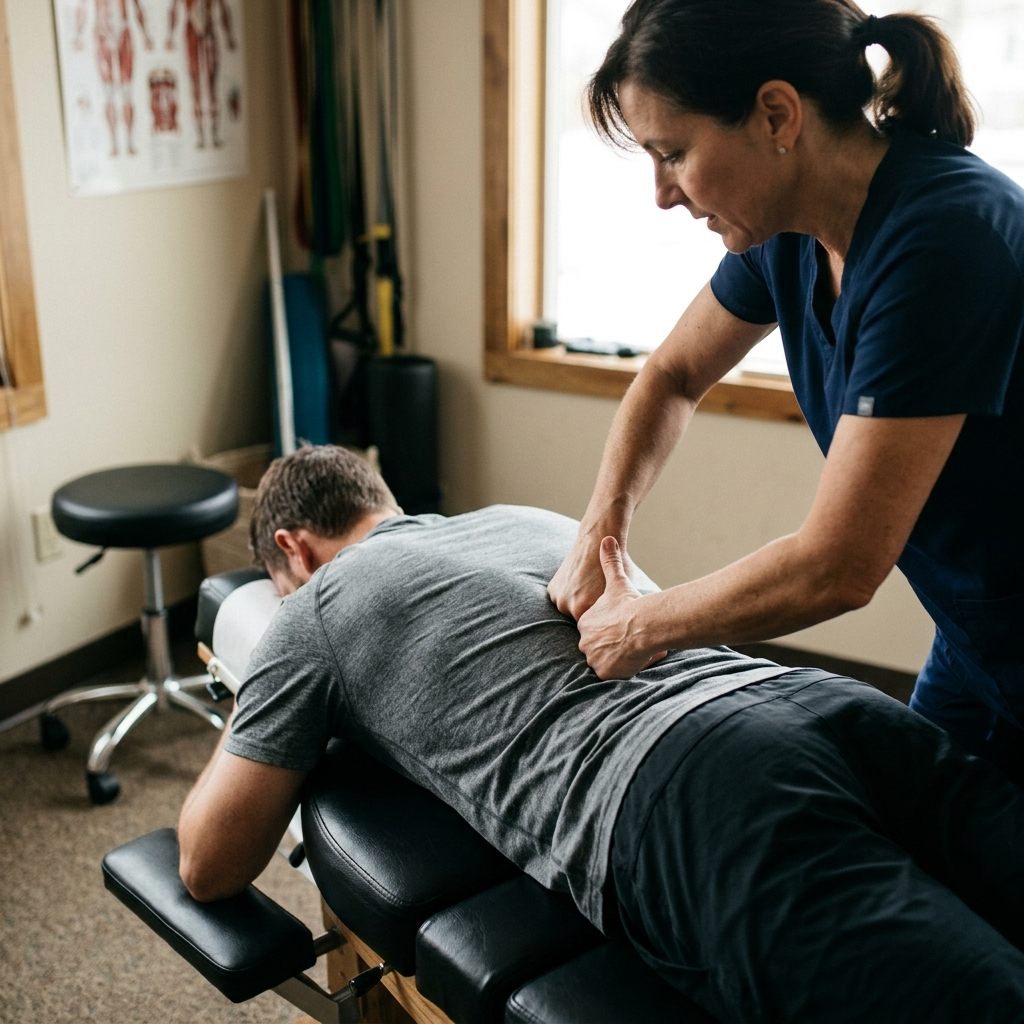
A chiropractor runs through a standard assessment. Range of motion tests. Postural observation. Spinal palpation. The patient came in complaining about lower back pain, neck stiffness, and right shoulder discomfort that gets worse at the gym.
What the practitioner finds tells a different story than the one the patient thought he was walking in with.
The shoulder pain originates in the neck. The lower back dysfunction stems from a twisted pelvis. The gym routine amplifies every misalignment instead of correcting it. And the 8+ hours spent sitting each day has turned specific vertebral segments into overloaded stress points that refer pain throughout the body.
This assessment reveals something bigger than one person’s musculoskeletal complaints. It shows how modern life creates predictable patterns of structural breakdown, and how most people unknowingly accelerate that breakdown while trying to stay healthy.
How Does One Postural Problem Create Multiple Pain Points?
The thoracic spine develops excessive forward curvature. Medical term: hyperkyphosis. Common term: that rounded upper back you see on everyone staring at screens all day.
Here’s what happens next.
The shoulders roll forward to compensate. That stretches the tendons and ligaments in the shoulder joint. The chest muscles tighten on one side more than the other. The deep spinal stabilizers develop asymmetrical tension patterns. The neck has to hyperextend just to keep the head upright, which loads the cervical spine in ways it wasn’t designed to handle.
One postural deviation creates a cascade of compensatory adjustments throughout the entire kinetic chain. You feel it as shoulder pain, but the root cause sits three segments away in your mid-back.
The body adapts brilliantly to dysfunction. That’s the problem. It adapts so well that you don’t realize how far off-center you’ve drifted until pain forces you to pay attention. By then, you’re not dealing with one issue. You’re dealing with an interconnected web of compensations that all need unwinding.
The Bottom Line: Postural deviations trigger cascading compensations throughout the kinetic chain. The body adapts so effectively to dysfunction that you don’t notice structural drift until pain forces attention – by then, you’re managing an interconnected web of compensations, not a single issue.
Why Does Sitting Damage Specific Parts of Your Spine?
Low back pain affects 619 million people worldwide right now. Projections show that number rising to 843 million by 2050. That’s a 36% increase driven largely by how we work and live.
Recent research found that sedentary behavior increases chronic low back pain risk by 2.7 times. People sitting more than 6 hours daily have a 33% higher risk compared to those sitting 2 hours or less.
But here’s what makes this particularly insidious: the damage concentrates in specific spinal segments.
Prolonged sitting and driving overload particular vertebral levels. The thoracolumbar junction, where your mid-back meets your lower back. The L3-L4 lumbar segments. These areas become stress concentration points. The supporting muscles fatigue. The segments themselves get loaded beyond their design capacity. Inflammation develops. Dysfunction sets in.
Your body doesn’t distribute sitting stress evenly across your entire spine. It hammers the same vulnerable spots over and over, shift after shift, day after day. Modern lifestyle patterns create predictable pathology in predictable locations.
The Bottom Line: Prolonged sitting doesn’t distribute stress evenly – it repeatedly overloads the same vulnerable spinal segments (thoracolumbar junction, L3-L4), creating predictable pathology in predictable locations because modern lifestyle patterns remain consistent.
What Happens to Your Brain When You Sit All Day?
The structural changes are visible on imaging. The functional limitations show up in range of motion tests. But something else is happening that most people never consider.
Prolonged sedentary time decreases gray matter volume in multiple brain regions. The primary somatosensory cortex. The secondary somatosensory cortex. The putamen. The primary motor cortex. The insula. The hippocampus. The amygdala.
Sitting isn’t just affecting your muscles and joints. It’s literally changing your brain structure.
The areas responsible for processing sensory information, coordinating movement, and regulating emotion are all impacted by how much time you spend motionless. The musculoskeletal dysfunction you can feel is accompanied by neurological changes you can’t directly perceive but that affect how your body processes and responds to the world.
The Bottom Line: Prolonged sedentary behavior decreases gray matter volume in brain regions responsible for processing sensory information, coordinating movement, and regulating emotion. The musculoskeletal dysfunction you can feel is accompanied by neurological changes you can’t directly perceive.
Why Does Exercise Sometimes Make Pain Worse?
The patient in this assessment goes to the gym regularly. He’s trying to stay healthy. But his shoulder pain gets worse during workouts, not better.
The practitioner explains why: when you perform resistance training with shoulders rolled forward, you increase strain and potential injury to shoulder structures. Exercise under poor alignment amplifies damage rather than preventing it.
Research confirms this pattern. High physical activity reduces back pain risk, but only up to a point. The lowest risk occurs in the 1,801 to 2,400 MET-minutes per week range. Beyond that, extremely high vigorous physical activity correlates with high risk, particularly in males.
This creates a U-shaped relationship. Too little movement causes problems. Too much movement under dysfunctional biomechanics causes different problems. The middle ground requires not just activity, but activity performed with proper structural alignment.
Mechanical efficiency plays the central role in shaping training adaptations. Integrating biomechanical principles into program design enables more targeted exercise selection, enhances motor control, reduces injury risk, and supports long-term performance development.
Translation: how you move matters more than how much you move. Form under load determines whether you’re building strength or accumulating structural debt.
The Bottom Line: Exercise creates a U-shaped risk relationship – too little movement causes problems, but high-intensity training under poor biomechanics causes different problems. Movement quality matters more than movement quantity because form under load determines whether you’re building strength or accumulating structural debt.
How Does Pelvic Alignment Affect Your Entire Spine?
The assessment reveals a twisted pelvis and leg length discrepancy. These aren’t separate issues from the back pain. They’re the foundation that everything else builds on.
A misaligned pelvis creates asymmetrical loading patterns throughout the lower back and spine. One side carries more weight than the other. Muscles on one side work harder to compensate. The spine curves to balance a foundation that isn’t level.
Correcting pelvic alignment releases tension in the lower back because it addresses the root cause rather than the symptom. You can treat back pain directly all day long, but if the pelvis remains twisted, the pain returns because the mechanical dysfunction persists.
The body is an interconnected structural system. Foundation issues manifest as symptoms elsewhere. You can’t fix the roof while ignoring the cracked foundation underneath.
The Bottom Line: A misaligned pelvis creates asymmetrical loading patterns throughout the spine. Treating back pain symptoms directly fails when the pelvis remains twisted because the mechanical dysfunction persists – you can’t fix the roof while ignoring the cracked foundation.
Why Does Pain Show Up in Different Locations Than the Problem?
Cervical spine restrictions at the C3 level generate pain that radiates to the shoulder joint. The patient feels shoulder pain. The problem lives in the neck.
This referral pattern repeats throughout the musculoskeletal system. Tight hip flexors contribute to lower back pain. Restricted thoracic mobility affects shoulder function. Ankle mobility limitations change knee loading patterns.
Treating symptoms at their location often fails because the root biomechanical dysfunction exists somewhere else in the kinetic chain. The pain you feel is real, but it’s frequently a secondary effect of primary dysfunction located in a completely different area.
This is why systematic assessment matters. You need to identify the source, not just address the symptom. Otherwise, you’re managing pain without resolving the underlying mechanical problem that keeps generating it.
The Bottom Line: Pain location doesn’t equal problem source. Referral patterns throughout the musculoskeletal system mean treating symptoms at their location often fails because root biomechanical dysfunction exists elsewhere in the kinetic chain.
How Does Sleep Position Impact Spinal Health?
Adults spend roughly one-third of their lives sleeping. That’s approximately 2,920 hours per year in a horizontal position.
Research shows that spinal misalignment during sleep significantly affects musculoskeletal discomfort and sleep quality. A systematic review recommends supine and supportive side-lying positions for better spinal health, while prone sleeping should be avoided.
The assessment addresses this directly: pillow choice and sleeping position have measurable impacts on cervical spine alignment.
This represents a massive therapeutic opportunity that remains largely unaddressed in mainstream health guidance. If you spend 8 hours per day in positions that reinforce dysfunction, your 1-hour corrective exercise session can’t overcome that imbalance.
Optimizing passive time matters as much as optimizing active time. Environmental modifications during sleep become essential components of treatment, not optional add-ons.
The Bottom Line: Adults spend approximately 2,920 hours per year sleeping. If you spend 8 hours daily in positions that reinforce dysfunction, 1-hour corrective exercise sessions can’t overcome that imbalance – passive time matters as much as active time.
What’s the Financial Case for Preventing Back Pain?
For every 1-minute increase in moderate-to-vigorous physical activity per week, there’s a 2.8 percentage point reduction in the probability of having a severe low back pain trajectory.
Replacing 1 hour per day of sedentary behavior with equal time of physical activity reduces incident back pain risk by 2% to 8%.
These numbers make the preventive case financially compelling. Back pain is expensive. Lost work days. Reduced productivity. Medical interventions. Chronic pain management. The downstream costs of untreated musculoskeletal dysfunction compound over time.
Early intervention through movement integration and postural correction costs less and works better than waiting for pain to develop before taking action. The ROI on prevention exceeds the ROI on treatment because it avoids the accumulated structural debt that makes treatment more complex and less effective.
The Bottom Line: Early intervention costs less and works better than reactive treatment because it avoids accumulated structural debt. The ROI on prevention exceeds treatment ROI because prevention sidesteps the downstream costs (lost work days, reduced productivity, medical interventions) that compound over time.
What Does This Mean for Healthcare and Fitness?
This session shows how contemporary work environments create predictable patterns of musculoskeletal dysfunction. The correlation between sitting time and specific spinal segment overload suggests that without systemic changes to workplace design and movement integration, musculoskeletal disorders will continue escalating.
It demonstrates how many chronic pain conditions result from accumulated biomechanical stress rather than acute injury. This points toward a healthcare paradigm shift from reactive treatment to preventive screening and movement education.
It highlights a critical gap in fitness culture. Without proper biomechanical assessment before beginning exercise programs, many people unknowingly reinforce dysfunctional movement patterns. The fitness industry needs better integration with corrective movement specialists.
It reveals that behavioral modification functions as primary therapeutic intervention. Patient education and habit change matter as much as manual treatment. Sustainable health outcomes require active participation, not passive receipt of care.
And it introduces the concept of structural debt: just as financial debt accumulates interest, biomechanical imbalances accumulate compensatory dysfunction over time. Early-stage minor imbalances, left unaddressed, progressively cascade into complex multi-system dysfunction.
The Bottom Line: This assessment reveals structural debt as a central concept – biomechanical imbalances accumulate compensatory dysfunction over time, just as financial debt accumulates interest. Healthcare must shift from reactive treatment to preventive screening, and fitness culture needs integration with corrective movement specialists.
The Question Worth Asking
The patient walked in thinking he had three separate problems: back pain, neck stiffness, and shoulder discomfort made worse by gym activities.
The assessment revealed one interconnected system operating under accumulated stress, with compensatory patterns layered on top of foundational misalignments, all amplified by modern lifestyle factors and well-intentioned but biomechanically flawed exercise habits.
How many people are treating symptoms without ever addressing the structural patterns generating those symptoms? How many are unknowingly accelerating dysfunction while trying to stay healthy?
And what changes when you start seeing your body as an integrated system where foundation determines function, where passive time matters as much as active time, and where the quality of movement outweighs the quantity?
Frequently Asked Questions
How much sitting is too much for spinal health?
Sitting more than 6 hours daily increases chronic low back pain risk by 33% compared to sitting 2 hours or less. Sedentary behavior increases overall chronic low back pain risk by 2.7 times. The damage concentrates in specific vulnerable segments (thoracolumbar junction and L3-L4 lumbar segments) rather than distributing evenly across the spine.
Can exercise fix posture problems caused by sitting?
Not automatically. Exercise under poor alignment amplifies damage rather than correcting it. When you perform resistance training with shoulders rolled forward or other misalignments, you increase strain and potential injury to those structures. Movement quality matters more than movement quantity – you need proper biomechanical assessment before beginning exercise programs to avoid reinforcing dysfunctional patterns.
Why does my shoulder hurt when the problem is in my neck?
This is called a referral pattern. Cervical spine restrictions (like at the C3 level) generate pain that radiates to the shoulder joint. Throughout the musculoskeletal system, pain location doesn’t equal problem source because the body is an interconnected structural system. Tight hip flexors contribute to lower back pain, restricted thoracic mobility affects shoulder function, and ankle mobility limitations change knee loading patterns.
How does pelvic alignment cause back pain?
A misaligned pelvis creates asymmetrical loading patterns throughout the lower back and spine. One side carries more weight than the other. Muscles on one side work harder to compensate. The spine curves to balance a foundation that isn’t level. Treating back pain symptoms directly fails when the pelvis remains twisted because the mechanical dysfunction persists at the foundation level.
What’s the best sleeping position for spinal health?
Research recommends supine (on your back) and supportive side-lying positions for better spinal health. Prone sleeping (on your stomach) should be avoided because it creates spinal misalignment. Pillow choice matters significantly for cervical spine alignment. Since adults spend approximately 2,920 hours per year sleeping, optimizing this passive time becomes essential – 8 hours of poor sleep positioning can negate 1 hour of corrective exercise.
What is structural debt and how do I know if I have it?
Structural debt is the accumulated compensatory dysfunction that develops over time from biomechanical imbalances, similar to how financial debt accumulates interest. Early-stage minor imbalances, left unaddressed, progressively cascade into complex multi-system dysfunction. Signs include pain in locations that don’t match the root problem, compensatory movement patterns, and symptoms that worsen despite well-intentioned exercise efforts.
How much movement do I need to prevent back pain?
Replacing just 1 hour per day of sedentary behavior with physical activity reduces incident back pain risk by 2% to 8%. For every 1-minute increase in moderate-to-vigorous physical activity per week, there’s a 2.8 percentage point reduction in severe low back pain probability. The lowest back pain risk occurs in the 1,801 to 2,400 MET-minutes per week range – beyond that, extremely high vigorous activity correlates with higher risk, particularly in males.
Should I see a chiropractor before starting a workout program?
Biomechanical assessment before beginning exercise programs helps identify existing misalignments and compensatory patterns. Without this assessment, many people unknowingly reinforce dysfunctional movement patterns during exercise. A systematic evaluation can identify whether shoulder pain originates in the neck, whether pelvic misalignment is creating asymmetrical loading, and which segments are already under excessive stress – all factors that determine whether exercise will help or harm.
Key Takeaways
-
Modern sedentary lifestyles create predictable structural breakdown in specific spinal segments – the damage doesn’t distribute evenly but concentrates in vulnerable areas like the thoracolumbar junction and L3-L4
-
Your body is an interconnected structural system where pain location rarely equals problem source – shoulder pain originates in the neck, back pain stems from pelvic misalignment, and compensatory patterns cascade through the entire kinetic chain
-
Exercise without proper alignment accelerates dysfunction rather than preventing it – movement quality matters more than quantity because form under load determines whether you’re building strength or accumulating structural debt
-
Passive time (sleep positioning, sitting posture) matters as much as active time – 8 hours of poor positioning can negate 1 hour of corrective exercise, making environmental modifications essential rather than optional
-
Prevention delivers better ROI than treatment because it avoids accumulated structural debt – early intervention costs less and works better than waiting for pain to develop and compound into complex multi-system dysfunction
-
Structural debt accumulates like financial debt – minor imbalances left unaddressed progressively cascade into compensatory dysfunction, requiring healthcare and fitness culture to shift from reactive treatment to preventive assessment